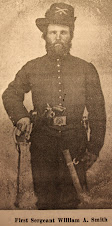
Finally got a spare minute to scan in letters written by Smith leading up to battle at Coffeeville and his untimely death. These letters just haunt me everytime I read them.
Emailed them to a gentleman working on the events surrounding this battle.
I miss working on my Civil War research, plan to get back to it one day in the not too distant future.
Tuesday, May 26, 2009


Thursday, March 12, 2009
Out of Touch
I really miss reading and blogging about the Civil War period. I promised myself I wouldn't let that happen. So, with that said....I am going to get back to it. Tonight I will start with reading my Great Grandfathers diary from the war.
I also need to get some information to a gentleman wanting information about the Battle of Coffeeville.
I also need to get some information to a gentleman wanting information about the Battle of Coffeeville.
Sunday, January 18, 2009
“Taps” Where did it come from?
The Myth goes something like this.
In 1862 Union Army Captain Robert Ellicombe was near Harrison’s Landing in Virginia. During the night through the sounds of battle, Captain Ellicombe heard the cries of a wounded soldier. Not knowing if the soldier was Union or Confederate, Captain Ellicombe decided to risk his own life and gather up the soldier and bring him into camp for medical care. The Captain crawled onto the battlefield with bullets flying and pulled the soldier to safety. In the dark, he could only make out that the young mans uniform was Confederate. Captain Ellicombe lit a lantern and placed it near the soldier and discovered it was his own son. His son was a music student in the South when the war began and without consulting his father, he joined the Confederate forces. Captain Ellicombe asked his superiors if he could give his son a full military burial and was granted a portion of his request. He was not allowed to use a full military band, but was told he could have one musician. The Captain selected a bugler. Captain Ellicombe recovered a piece of paper with music notes on it in his son pocket. Realizing his son must have written it, he requested the bugler play it as they laid his son to rest. This haunting melody we now know as “Taps” is used at military funerals.
The Truth [An Excerpt From Twenty-Four Notes That Tap Deep Emotions: The story of America's most famous bugle call by Jari Villanueva]
Taps began as a revision to the signal for Extinguish Lights (Lights Out) at the end of the day. Up until the Civil War, the infantry call for Extinguish Lights was the one set down in Silas Casey's (1801-1882) Tactics, which had been borrowed from the French. The music for Taps was adapted by Union General Daniel Butterfield for his brigade (Third Brigade, First Division, Fifth Army Corps, Army of the Potomac) in July, 1862. As the story goes, General Butterfield was not pleased with the call for Extinguish Lights, feeling that the call was too formal to signal the days end, and with the help of the brigade bugler, Oliver Willcox Norton (1839-1920), wrote Taps to honor his men while in camp at Harrison’s Landing, Virginia, following the Seven Days battle. These battles took place during the Peninsular Campaign of 1862. The new call sounded that night in July, 1862, soon spread to other units of the Union Army and was reportedly also used by the Confederates. Taps was made an official bugle call after the war.
The first time I heard Taps, I was 9 years old and we were burying my father at Fort Sam Houston Cemetery in San Antonio. Myth or Truth, this song touches the soul.
Saturday, January 3, 2009
Buglers in the Civil War
These heroic men, Union or Confederate were in large part the foundation of any camp during the Civil War. They would provide entertainment, alarm services for duties, and relayed calls during battle. Buglers were generally associated with cavalry and artillery, while drums were with the infantry.
Gustav Shurmann known as "The Little Bugler" rode with several commanders, one was Daniel Sickles…which if you have followed my blog, you know I have a fascination for this man.
Gustav was only 12 years old when he started riding in the war. Buglers would ride alongside the commanders in battle, it was thought since the sound of the bugle carried so well…it was the best source of organization during battle. During the heat of battle, you could still hear the bugles play above the cannons and guns.
The letters from Union Sergeant William A. Smith, mention the buglers regularly. After reading the letters, I felt the buglers were the glue holding the men together and helped them get through each day whether battle or at rest.
Smith's Letter dated February 15th, 1862 with location Cape Girardeau, Missouri
My Dear Wife
I once more take my pen to address you a few lines to let you know that I am still on times side of Eternity, enjoying good health and I believe a reasonable mind, hoping you and the children are in good health.
…A man cannot die in a better cause….The Captain goes to Cairo by the first boat, to get our carbines….
(and he ends his letter) …The bugle is sounding 8 o’clock roll call, so good night.
Wednesday, December 31, 2008
USS Constellation
USS Constellation, the last all sail warship built by the US Navy, is open to the public as a museum in Baltimore's Inner Harbor. The USS Constellation Museum invites guests to discover life on board the only Civil War era vessel still afloat and explore the ship's maritime history.
I have been through this ship and it is facinating. It is well worth the time to tour through it and visit the harbor when in the area.
I have been through this ship and it is facinating. It is well worth the time to tour through it and visit the harbor when in the area.
Sunday, December 28, 2008
Knights of the Golden Circle 1860 Election
11/5/1860 a letter from Union Soldier refers to the election about to begin and how they arrested Knights of the Golden Circle!!! KGC was to lay the groundwork for annexation of territories in Mexico, Central America, & Caribbean to be included w US as slave states.
Knights of the Golden Circle (KGC) was a secret society originally founded to promote the interests of the Southern United States.
Most of the time, families knew more what was going on than the soldiers. Families had the advantage of reading the paper. Soldiers would wait for newspapers to be sent from home to learn the news.
1860 was historical for many reasons, but probably the most important was the election of Lincoln! This one act would set off a chain of southern states secessions.
Saturday, December 27, 2008
The Presidential Election of 1860
Abraham Lincoln won the support of the Republican National Convention.
The Democratic National Convention was held in South Carolina, with a second meeting in Maryland. During the convention, 110 Southern Delegates, walked out when the party would not adopt a platform endorsing the expansion of slavery into new/future territories. The Democrats that remained, nominated Stephen A. Douglas for the presidency. The Southern Democrats held another convention in Virginia, nominating John Breckinridge.
The former Know Nothings with some Whigs formed the Constitutional Union Party running on a platform supporting the Constitution.
November 6; Republican Candidate Abraham Lincoln was elected President of the United States, with Hannibal Hamlin as his Vice President. This brought on the secession of the Southern States, starting with South Carolina.
Friday, December 26, 2008
Quote by Thomas Jefferson
"Do you want to know who you are? Don't ask. Act! Action will delineate and define you. " Thomas Jefferson
Thomas Jefferson died in 1826, long before the Civil War. I just think he was brilliant and my mom is named after him....
My Great Grandfather was named after Thomas Jefferson. My mother was named after her grandfather, (there were no boys), her name is Jeff Bratton.
Monday, December 1, 2008
Nurses, Spys, Union and Confederate Soldiers, Sutlers
There were a few women awarded pensions after the war. The numbers vary, but were around 300 +- women served. These women would dress and present themselves as men, wearing loose clothing, short hair, bathed in their underwear, and sometimes sporting fake mustaches.
One I found very interesting was Loreta Valezquez. She laid many claims in her memoirs in later years; even without validation of all her claims, she had a very interesting life. She claimed she was disguised as a female spy at one point for the Confederate Army. Imagine, a woman pretending to be a man, pretending to be a woman. She served as Lieutenant Harry Buford fighting at the First Bull Run, Fort Donelson, and Shiloh.
Many women served as nurses and Sutlers assisting the troops in the field and at home. Sutlers were basically merchants; selling goods to the troops.
Ahhh the prostitutes! Must have been relatively common; as I read through letters from Union and Confederate soldiers, they refer to these women coming in and out of camp on a regular basis.
Officers had their wives come into camp and stay with them in their tents. These women would cook, clean and take care of their men.
Thursday, November 27, 2008
Thanksgiving Proclamation of 1863
By the President of the United States of America.
A Proclamation.
The year that is drawing towards its close, has been filled with the blessings of fruitful fields and healthful skies. To these bounties, which are so constantly enjoyed that we are prone to forget the source from which they come, others have been added, which are of so extraordinary a nature, that they cannot fail to penetrate and soften even the heart which is habitually insensible to the ever watchful providence of Almighty God. In the midst of a civil war of unequaled magnitude and severity, which has sometimes seemed to foreign States to invite and to provoke their aggression, peace has been preserved with all nations, order has been maintained, the laws have been respected and obeyed, and harmony has prevailed everywhere except in the theatre of military conflict; while that theatre has been greatly contracted by the advancing armies and navies of the Union. Needful diversions of wealth and of strength from the fields of peaceful industry to the national defence, have not arrested the plough, the shuttle or the ship; the axe has enlarged the borders of our settlements, and the mines, as well of iron and coal as of the precious metals, have yielded even more abundantly than heretofore. Population has steadily increased, notwithstanding the waste that has been made in the camp, the siege and the battle-field; and the country, rejoicing in the consiousness of augmented strength and vigor, is permitted to expect continuance of years with large increase of freedom. No human counsel hath devised nor hath any mortal hand worked out these great things. They are the gracious gifts of the Most High God, who, while dealing with us in anger for our sins, hath nevertheless remembered mercy. It has seemed to me fit and proper that they should be solemnly, reverently and gratefully acknowledged as with one heart and one voice by the whole American People. I do therefore invite my fellow citizens in every part of the United States, and also those who are at sea and those who are sojourning in foreign lands, to set apart and observe the last Thursday of November next, as a day of Thanksgiving and Praise to our beneficent Father who dwelleth in the Heavens. And I recommend to them that while offering up the ascriptions justly due to Him for such singular deliverances and blessings, they do also, with humble penitence for our national perverseness and disobedience, commend to His tender care all those who have become widows, orphans, mourners or sufferers in the lamentable civil strife in which we are unavoidably engaged, and fervently implore the interposition of the Almighty Hand to heal the wounds of the nation and to restore it as soon as may be consistent with the Divine purposes to the full enjoyment of peace, harmony, tranquillity and Union.
In testimony whereof, I have hereunto set my hand and caused the Seal of the United States to be affixed.
Done at the City of Washington, this Third day of October, in the year of our Lord one thousand eight hundred and sixty-three, and of the Independence of the Unites States the Eighty-eighth.
By the President: Abraham Lincoln
Tuesday, November 18, 2008
Snow on the Mountain
We woke up to a beautiful blanket of snow this morning and it is still coming down. I just can't imagine how the troops during the civil war were able to maneuver through the country in this type of climate. We sit in our heated homes all cozy and can choose when to step out and hop into our preheated vehicles. Union and Confederate troops were on foot or horse with light clothing (compared to today’s standards) and not much in the way of food rations most of the time.
Thursday, November 13, 2008
More on the RAT General Sickles
Remember I mentioned how the public was more forgiving of him murdering his wife's lover than of him forgiving his wife for the infidelity? When he confronted his wife, Teresa Bagioli Sickles about the affair, she denied it, but later recanted and even put her CONFESSION IN WRITING…..Good lord what was she thinking? My guess is, she only started the affair because her husband was way too busy with all his other women and had no time for her.
I ran across this tidbit while reading some of the excerpts from “Harper’s Weekly – Journal of Civilization”…they published the confession. Well no wonder the public hated her, can you imagine?? She died from tuberculosis in 1867.
I ran across this tidbit while reading some of the excerpts from “Harper’s Weekly – Journal of Civilization”…they published the confession. Well no wonder the public hated her, can you imagine?? She died from tuberculosis in 1867.
Harper's Weekly Quote
“War is sorrowful, but there is one thing infinitely more horrible than the worst horrors of war, and that is the feeling that nothing is worth fighting for....” -- Harper's Weekly, December 31, 1864
Tuesday, November 11, 2008
Letters From a Union Soldier
A friend gave me over 100 letters written by her GGGGrandfather during the civil war. The letters are addressed to his wife and take you from the opening of the war (first letter dated August 1861 ) through the end of 1862 (last letter dated November 29, 1862). He fell during the battle of Coffeeville, Mississippi on the 5th of December.
He started out in Camp Butler which was a large military training camp in Illinois. His spirits were high and he was honored and proud to be serving “Uncle Sam” as he put it.
It was obvious he loved his family, he wrote so often, full of hope great ideals.
He started out in Camp Butler which was a large military training camp in Illinois. His spirits were high and he was honored and proud to be serving “Uncle Sam” as he put it.
It was obvious he loved his family, he wrote so often, full of hope great ideals.
Give Thanks
Today is Veterans Day, THANK A VET.
Growing up military and living on base we experienced a daily ritual. A retreat ceremony, was held everyday at 5pm when no matter where you were (in the swimming pool, BX, or officers club), you stopped, turned towards the main flag on base and covered your heart with your right hand and had a minute of peace as they lowered the flag. There was something very reassuring about this.
Growing up military and living on base we experienced a daily ritual. A retreat ceremony, was held everyday at 5pm when no matter where you were (in the swimming pool, BX, or officers club), you stopped, turned towards the main flag on base and covered your heart with your right hand and had a minute of peace as they lowered the flag. There was something very reassuring about this.
Monday, November 10, 2008
Great Grandfather's Diary from Civil War
Finally got it to the Arkansas Historical Commission so they could copy it. Have helped a few people locate their relatives during that time. The internet is a fabulous tool.. can share information so quickly. Had a young man email me, had seen a posting with a relative of his. It was a page from our diary. Helped him to locate his gggrandfather during the war.
Friday, November 7, 2008
The Revenue Act of 1861
The Revenue Act of 1861, was the first Federal Income Tax Statute. “There shall be levied, collected, and paid, upon annual income of every person residing in the US whether derived from any kind of property, or from any professional trade, employment, or vocation carried on in the United States or elsewhere, or from any source whatever.”
Rates were 3% on an income above $800.
Rates were 3% on an income above $800.
Thursday, November 6, 2008
Lady's Book by Louis Godey
I was reading one of my history books and ran across this bit of information I found interesting.
Women were taking on stronger family roles. The industrial revolution was expanding from Europe to the US Northeast and slowing filtering South and West. As this was happening, furniture, clothing, shoes etc were dropping a bit in price due to the fact they were being made in factories instead of by artisans. Also there were campaigns in various states, leading up to the Civil War. Men were away from home, women were becoming more independent. This was changing how Americans were living. Women started relying on a book “Lady’s Book” by Godey’s, to educate and assist with their buying decisions, source of recipes, clothing patterns, poetry, music etc etc…..designed to inform WOMEN how to be LADIES of the time. It was expensive, but women came up with the money.
In 1845, Louis Godey began copyrighting each issue to prevent other magazines and newspaper editors from pirating their texts. This was a first in America.
What is even more cool….I have the January 1855 Book, purchased years ago in a little shop in Virginia. It dawned on me after reading about it….I had that same book. Pretty cool.
Wednesday, November 5, 2008
General Sickels
One of my favorite stories actually took place just prior to the Civil War. In 1859, a New York congressman, Daniel Sickles shot and killed Phillip Barton Key (son of Francis Scott Key) the US State Attorney for DC. Sickles discovered Key was carrying on an affair with his wife and shot him in Layfayette Square just north of the White House. Sickles was later acquitted based on a defense of temporary insanity (the first successful case in the US).
Sickles forgave his wife and stayed with her. The general public was very critical of the fact he did that. It didn’t matter that he took a prostitute to England on one of his junkets, even introducing her to the Queen.
During the war he was given the position of General and prior to the battle of Gettysburg, he moved his troop to higher ground , beyond the position he was ordered to hold. He lost most of his men and it is said he totally compromised the battle because he didn’t follow orders. He was also shot in the leg with a cannon ball. He gathered up the cannon ball and asked the doctors to keep the broken shin bone so he could donate it to a museum after the war (both are now in the Smithsonian Museum).
He would return to congress after the war.
Saturday, November 1, 2008
Politics
You know we think politics is unique in our time, its not. It is amazing to read some of these books about how dirty politics was...same as today.
Subscribe to:
Posts (Atom)